Emma's educational round-up
A weekly/fortnightly insight into developments within the realm of education.
My recommendations
News
There has been much talk about AI in education, both at BETT and in the media recently. Do have a read of Anthony David’s article, ‘AI homework – Let’s redefine what homework is and what it’s for’, which gives plenty of food for thought.
https://www.teachwire.net/news/ai-homework
The Geographical Association (GA) highlights from 2025 can be viewed here: https://geography.org.uk/2025-highlights-with-the-geographical-association/. How many have you engaged with? Are there any that you have yet to read/watch? Certainly a very valid reason to become a member of one of geography’s leading subject associations!
Geographical Association (GA) blog
Those of you involved in teacher training or mentoring should have a read of Vicki Pountney’s blog post, ‘Using the GA Initial Teacher Education webpages to support professional reflection and conversations with novice teachers’. There are many resources out there to support you.
Website
Our World in Data
A fantastic website containing a wealth of up-to-date articles, diagrams, infographics, graphs, etc. (https://ourworldindata.org/).
Did you know that you can now select a specific year or date in their interactive charts?
Many of their interactive charts feature long time series and it can be difficult to select the exact year or date that you want to see data for. Their data visualization tool has been upgraded to make this much easier — now you can simply type a specific year or date in the timeline at the bottom of a chart to select it. Just hover over the timeline selector and a text box will appear. This is currently only available for desktop users.
Post factum
BRICS, EXPLAINED: Multipolarity, currency and energy
One to share with GCSE and A level students. All you need to know (and more) in a quick and easy read: https://www.postfactum.co.uk/brics-countries-currency-china-india-russia-brazil-south-africa-bloc-trade-saudi-arabia-iran-bric-uae-indonesia-egypt-ethiopia-turkey-what-is-multipolarity-geopolitics
Resource/s
During a GlosGeog/Met. Office/Climate Ambassadors collaborative CPD workshop last week, I was reminded of the National Education Nature Park’s fantastic Habitat mapping: a Nature Park guide. This makes an easy and purposeful local fieldwork activity with a sustainability theme. Check it out if you have not done so already.
https://www.educationnaturepark.org.uk/resource/habitat-mapping-a-nature-park-guide
Book/s
A picture book for EYFS upwards …
The Secret Sky Garden by Linda Sarah and Fiona Lumbers was mentioned by Edd Moore during a recent climate action planning CPD workshop. Although it was published a while ago, it is a book that I have not encountered before. Edd highly recommended it as a means of introducing themes, such as climate change and sustainability.
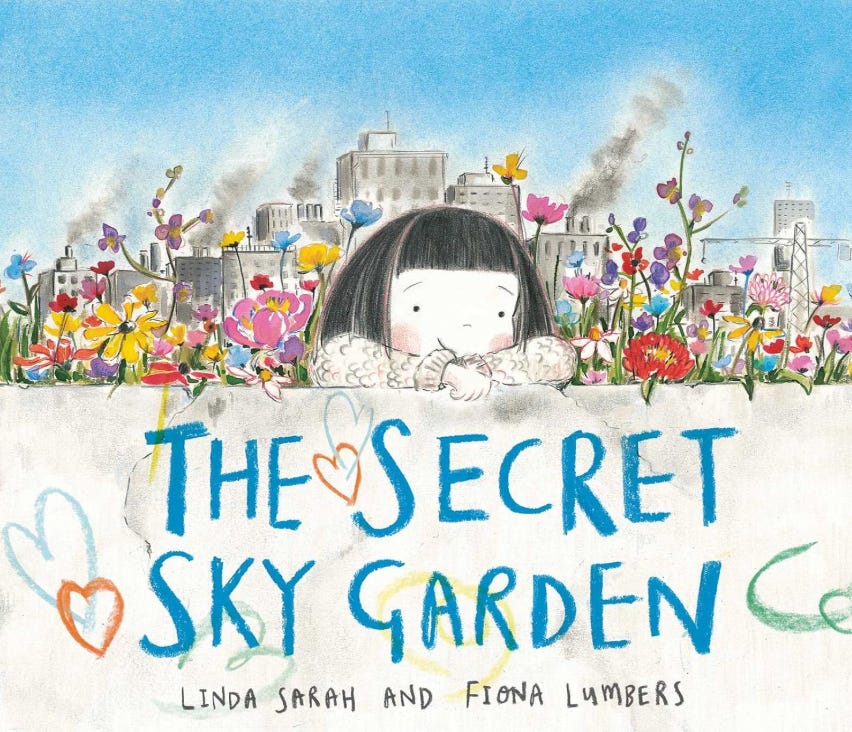
A startlingly original picture book about a little girl who creates a garden on a disused car park rooftop
Funni loves the old, disused car park, and spends a lot of time there flying her kite and playing her recorder. But something is missing. Definitely. So Funni decides to create a garden in the neglected space and after weeks of careful nurture, her garden in the sky takes shape. One day, a little boy, Zoo, spots the square of colour amongst the grey from an incoming flight, and decides to try to find it. And slowly, not only do Funni's flowers bloom, but a very special friendship blossoms too.
https://www.amazon.co.uk/Secret-Sky-Garden-Linda-Sarah/dp/1471119262
And, continuing these themes …
Take a look at the Padlet that Marie has created, which brings together a range of children’s books exploring climate change and caring for our planet. As she reinforces, ‘thoughtfully chosen stories can be a powerful way to support children’s interests, encourage curiosity, and open up meaningful discussions about sustainability and environmental responsibility’.
Plus, a new book, aimed at 9 to 11 year olds, from award-winning author, Adiba Jaigirdar.
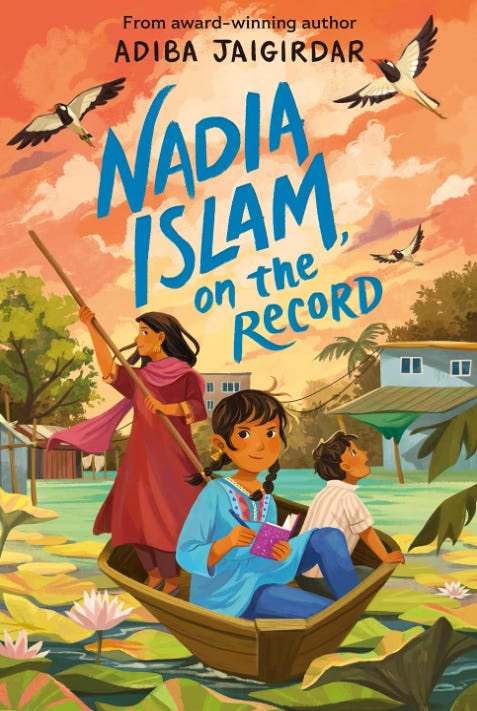
A heartwarming and authentic story that explores family, religion and fighting for what's right.
Aspiring journalist Nadia Islam hates that she's missing out on spending Ramadan with her best friend to go to Bangladesh. But the trip unexpectedly puts her reporting skills to the test.
Her journalist aunt - Nadia's Khalamoni - is in Bangladesh too, but not just for Ramadan or Eid, like Nadia. She's there to write a story on the increasing climate change problem in Bangladesh and how people are being affected by it. The more Nadia learns from her khalamoni, the more eager she is to help.
Her brother and cousins try to distract her with a Ramadan competition. She wants to beat them all - of course! - but her aunt needs her too.
Can Nadia put aside her competitiveness to beat her brother and cousins to figure out what Ramadan is really all about?
Podcast
How close is Greenland to the United States?
Thanks to Steve Brace, Chief Executive at the Geographical Association (GA), for this recommendation.
Great to hear Jay Foreman - who with #geographer Mark Cooper-Jones - produces the #MapMen videos and books - talking with Tim Hartford on BBC's #Moreorless about the importance of maps and globes in assessing Greenland's geo-political importance.
It also includes consideration of how the Mercator projection - widely used in the US - distorts Greenland's size. It makes Greenland look the same size as Africa, when Africa is 14 times larger than Greenland.
https://www.bbc.co.uk/programmes/p0mw3jzm
TV programme/movie clip
Time for Geography has recently released a new series, entitled ‘Understanding Earthquakes’, ideal for enhancing teaching and learning at GCSE and A level.
‘What are earthquakes and why do they occur?’: https://timeforgeography.co.uk/videos-container/what-are-earthquakes-and-why-do-they-occur/
‘How do we forecast earthquakes?’: https://timeforgeography.co.uk/videos-container/earthquake-research-forecasting/
App/game
Top Geographers
This game introduces younger students to job roles that use geographical skills and knowledge. Download the cards and find out how to play here: https://www.rgs.org/schools/resources-for-schools/top-geographers
‘Geography in the news’
Some positive energy-related news to share with secondary-aged pupils:
Do you wish your A level students to stand out from the rest? Encourage them to reference more unusual case studies to demonstrate wider reading, such as this, flagged up by Iain Palot last week:
https://www.wfp.org/publications/indigenous-peoples-case-study-climate-change-bolivia
CPD
*ONLY A COUPLE OF TICKETS NOW LEFT*
Details about the next virtual Primary Geography Subject Leader Network (PGSLN) meeting with a guest appearance from Mark Enser can be viewed here: https://www.eventbrite.co.uk/e/virtual-primary-geography-subject-leader-network-pgsln-meeting-tickets-1977730390838.
Hope you are able to join us to hear updates about the new Ofsted Education Inspection Framework (EIF) and the Curriculum and Assessment Review (CAR), plus consider what ‘writing like a geographer’ implies and the development of subject-specific vocabulary.
Competition/challenge
The My Environment My Future (MEMF) competition is now open.
One small, but important update this year: they have expanded the competition to include primary schools and entries are now organised by Key Stage rather than age (Key Stage 2 to Key Stage 5).
Entries may comprise a poster, presentation or short video by individuals or groups of up to four. There are more resources on the MEMF website to help you, including a brief for students and teachers, summary of last year’s winning entries and presentation templates, which you might wish to use. Entries need to be e-mailed to info@memf.careers and you will receive an acknowledgement. If you have problems sending due to file size, then they can organise a file transfer or you can upload directly to their SharePoint.
There is no rush as the competition is open until 1st May 2026.
https://memf.careers/resources/school-competition/
Opportunities for pupils
Earth Energy Education
Schools can visit a solar farm to understand how solar panels work and how we can produce electricity from them to power everyday items, reducing the consumption of electricity from the grid.
They also come to schools and run FREE workshops that include carbon footprint, solar investigations, solar toy junk modelling, solar car make and race challenge, wind turbine blade design and power your school–renewable investigations.
https://www.earthenergyeducation.com
Global Goals Centre
As part of Earth Day celebrations around the world, the Earth Day Heroes project invites young people to become an Earth Hero and create a local project to raise awareness and take action on environmental issues that matter to them. Using creativity, problem solving and learning from other young people, it encourages young people to respond positively to the problems they see in the world around them, developing global citizens and improving health, wellbeing and the climate.
The action might be a one-off event, such as tree planting, making a poster or writing campaign material, which can be completed in one or two lessons/sessions. Young people may also wish to undertake a much longer project that suits their group or class: last year, these included a bike bus, balcony garden and an art exhibition! If you are interested in taking part, you can sign up for more info here.
Hope the above provides some inspiration and saves you time. Do let me know if you make use of any of the recommendations or have others that I have missed; I do love to hear about, and see evidence of, pupils in action both in and beyond the classroom.
Emma Espley