Emma's educational round-up
A weekly/fortnightly insight into developments within the realm of education.
It was lovely to receive the below feedback from one subscriber last week:
I am a new subscriber this year and I just wanted to say thank you for your email round-ups – I find them really inspiring and always useful! I have managed to engage with a few of the suggestions and events and look forward to doing so more next year!
My recommendations
News
As per Steve Brace, Chief Executive Officer at the Geographical Association (GA):
There will a public consultation on the draft National Curriculum and revised Subject Knowledge requirements for GCSE in September.
Department for Education has made the following announcement:
’The national curriculum and GCSEs are being updated for the first time in over a decade. A public consultation on the draft programmes of study and subject content for the first group of GCSEs will open this September. The revised curriculum will be published next Spring, with support to begin first teaching in September 2028. The first updated GCSEs will be taught from September 2029. The expertise, insight and experience of the education sector will be vital in shaping these reforms, and we look forward to working together throughout the process. More details on how to get involved will follow when the consultation launches.’
The Geographical Association encourages primary and secondary colleagues to take part in this consultation and we will share more details when it opens.
Geographical Association (GA) blog
A post to coincide with #NationalFestivalofFieldwork …
Here, Joe Follows discusses ‘Fieldwork at Great Ballard: geography that gets mud on its boots’ (https://geography.org.uk/blogs/fieldwork-at-great-ballard-geography-that-gets-mud-on-its-boots/).
Meanwhile, in conjunction with GlosGeog (Gloucestershire’s local Geographical Association [GA] branch), Dan Raven-Ellison and myself marked #NationalFestivalofFieldwork last week, challenging more than 600 teachers and Key Stage 2 pupils from 10 schools across the UK to a local fieldwork activity. Fortunately, the rain held off until later on in the day. Judging by the feedback received from teachers and pupils and photographs that have been shared with us, all seemed to really enjoy the experience and have, subsequently, been inspired to ‘take learning beyond the classroom’ and explore their local area more frequently. Mission accomplished!
Read all about the event here: https://create2inspire.co.uk/2026/06/02/marking-nationalfestivaloffieldwork2026/
You may be able to replicate it in your school grounds/neighbourhood too.
The Bank of England has revealed the shortlist of animals bidding to become the new faces of banknotes. Puffins, hedgehogs, dolphins and barn owls feature on a shortlist put together by a panel of wildlife experts, with a public vote set to decide which will feature on updated £5, £10, £20 and £50 notes. You have until 3rd July 2026 to cast your votes: https://www.bankofengland.co.uk/banknotes/help-us-design-our-next-series-of-banknotes.
Website
BBC Bitesize for Teachers and the Geographical Association (GA) have worked together to create FREE, curriculum-aligned classroom resources.
For use with Key Stage 2 pupils, there are new videos exploring and contrasting the six major Biomes of Earth and investigating different types of Settlements, as well as the factors that govern Changing land use.
At Key Stage 3, there are new videos exploring Plate Tectonics and the human and physical geography of the continent of Africa.
Attempts have been made to map existing Bitesize for Teachers classroom videos to curriculum objectives for Primary and Secondary, providing new teaching notes for each video.
Resource
AQA Geography Teaching Pack: Bangladesh & Dhaka
In-Depth Country Study | Urban Issues & Challenges | Tropical Storms
In partnership with AQA, Discover the World Education has created a FREE, comprehensive GCSE Geography resource pack that brings Bangladesh to life. Through three clear and engaging parts, this resource tackles both physical and human geography themes, including the tropical storm Amphan and Dhaka’s rapid urban growth.
Access the resource here: https://www.discover-the-world.com/study-trips/bangladesh-dhaka-aqa/
Book/s
The Week Junior Book Awards 2026
The shortlist, divided into various categories, can be found here: https://www.theweekjuniorbookawards.co.uk/26/fullshortlist26
There are several that have a geographical link and are well worth exploring further.
Youngsters can also vote for Children’s Choice and the Cover of the Year (https://www.theweekjuniorbookawards.co.uk/votelandingpage/12180257).
And, one for those engaged with secondary teaching and learning. There has been much talk about this book, which was published towards the end of May. Many departments are usually thinking about curriculum planning and development at this time of year. One to dip into in light of the impending changes to the National Curriculum, perhaps?
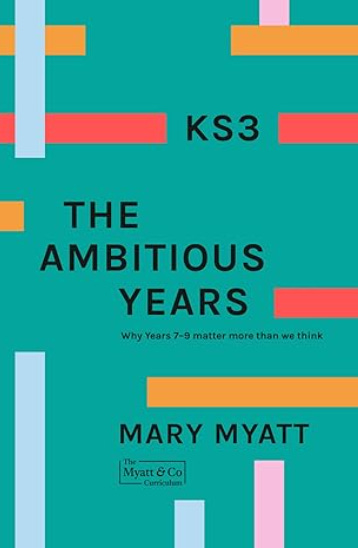
In KS3: The Ambitious Years, Mary Myatt sets out a clear and practical approach to curriculum and teaching in Years 7–9.
Drawing on research, classroom practice and years of working with schools and trusts, this book challenges the idea that KS3 is a holding stage and shows how it can become the most powerful phase in a pupil’s education.
Inside, you’ll find:
Why KS3 has been underpowered, and the consequences for KS4
What strong KS3 looks like in practice
How to design a curriculum built on depth, not coverage
The role of reading, vocabulary and knowledge in securing understanding
Practical steps for leaders and teachers to implement change
This is not a book of quick fixes.
It is a call for clarity, coherence and ambition, for every pupil.
https://www.amazon.co.uk/KS3-Ambitious-Years-matter-think/dp/0995668728
Podcast
Rare Earth: Leaving fossil fuels behind
Is the conflict in Iran, with its knock-on effect on oil supplies, accelerating the shift away from fossil fuels? Tom Heap and Helen Czerski debate the issues with a panel of experts: Josh Gabbatiss from the environmental journalism website Carbon Brief; Helen Thompson, Professor of Political Economy at Cambridge University; and Cornish farmer Stuart Oates.
https://www.bbc.co.uk/sounds/play/m002ww0s
TV programme/movie clip
We are hearing lots about El Nino at present; it could be one of the strongest in decades with the effects felt globally.
Short video clip: https://www.bbc.co.uk/news/videos/c8e8zzw30zyo
Read more here (some fantastic graphics included): https://www.bbc.co.uk/news/resources/idt-54f4e985-a7fb-48b2-8246-f3be0d699402
App/tool/game
World Cup fever is setting in as the first games are on the horizon.
Last week, Briley Habib posted on LinkedIn about an enquiry lesson, including the creation of Top Trumps cards.
Geography teachers, are you ready for the World Cup? Here is an enquiry lesson your students are going to love. Students will create their own Top Trump cards based on a range of indicators. After playing the game, they will then answer the enquiry question: does national wealth correlate to elite football success, or can smaller/poorer nations successfully bridge the gap? Once they have worked out their Spearman’s Rank coefficient, they will then answer their analysis.
Rich enquiry using higher order stats tests for Year 9, what more could you want?
Template for Canva Top Trumps are in the slides.
In addition, Stefan Carron’s recent Substack post (‘Case Study Corner: The FIFA World Cup 2026: Where is the geography?’) offers some fantastic ideas for integrating this into geography lessons at secondary level.
‘Geography in the news’
For anyone focusing on tourism/sustainable development at GCSE or A level:
https://www.theguardian.com/australia-news/2026/may/30/australia-great-barrier-reef-island-resorts
CPD
Primary
From resource to curriculum: making Oak geography work in your primary classroom
This FREE virtual CPD event on Wednesday 10th June 2026, from 4.00 pm to 5.00 pm, is open to everyone and led by Graeme Schofield from Oak National Academy. Graeme supported a GlosGeog/University of Gloucestershire GIS day that we ran recently and he was brilliant! If I did not have existing commitments on the day at this time, then I would definitely be joining the session. Here, he intends to explore Oak’s high-quality, free and adaptable primary geography curriculum, developed in partnership with the Geographical Association (GA). It includes a look at how research and evidence underpin the curriculum, alongside the key decisions that inform its sequencing, including how learning begins with pupils’ local geographies before extending outwards to wider regional, national and global contexts.
https://portal.geography.org.uk/event/view/E000220
Primary and secondary
Just in time for #NationalFestivalofFieldwork! The Royal Geographical Society (RGS-IBG) has collaborated with expert Chloë Searl (aka The Island Geographer) to create a FREE suite of curriculum-linked, self-led fieldwork CPD modules for teachers.
These videos, which include activities and reflection points for individuals and departments, help teachers fully embed meaningful fieldwork opportunities into their curriculum, showcase what is really meant when reference is made to high-quality fieldwork and explore the progression of fieldwork skills across key stages.
https://www.youtube.com/playlist?list=PLizNzrM10r9Huo94thKzqX5igNFUG-OAH
Competitions/challenges
Primary/secondary
The Summer Reading Challenge (Read to the Beat) launches on 19th June 2026. Discover more about the challenge here: https://summerreadingchallenge.org.uk/
There is a School Zone for teachers that is well worth exploring; plenty of FREE resources and ideas (https://summerreadingchallenge.org.uk/school-zone-src).
100 Ways to Save the World challenge
The Week Junior Science + Nature magazine is running a 100 Ways to Save the World challenge. Access https://sciencenature.theweekjunior.co.uk/100waystosavetheworld to find inspiration; there are suggestions for helping animals at risk of extinction, saving energy, tackling plastic pollution, etc. To take part, select one of the 100 planet-friendly activities to exemplify how small actions can make a big difference in helping to protect the future of our planet. Share what you achieve via the online form on the website before 28th June 2026. Everyone who completes an action will receive a special certificate and they may even be featured in a forthcoming edition of The Week Junior Science + Nature magazine.
Opportunities for pupils
National Oceanography Centre's 2026 Virtual Work Experience Week
During early August, the Creative Tuition Collective (CTC) x National Oceanography Centre (NOC) have a week’s virtual work experience for UK students between the ages of 14 and 19 years with an interest in ocean science, STEM, creativity or alternative career pathways.
Details about this year’s programme can be found here: https://docs.google.com/forms/d/e/1FAIpQLSftZPrGWLyQRHgJQHQg5xUhPejnZfnlc6AFA2qU4m2K1Rk7hQ/viewform?pli=1
Hope the above provides some inspiration and saves you time. Do let me know if you make use of any of the recommendations or have others that I have missed; I do love to hear about, and see evidence of, pupils in action both in and beyond the classroom.
Emma Espley